


The question surfaces in boardrooms and IT planning sessions regularly now. If ChatGPT can summarize a 40-page contract in under ten seconds, do organizations still need dedicated document processing software?
The question is understandable. But it misses the point, and that misunderstanding leads to expensive decisions.
Think of it this way: a large language model is an extraordinary engine. It converts input into output: fast, fluently, and often impressively. But an engine alone doesn't get you anywhere. You need the car. A business doesn't run on outputs alone. It needs data routed, validated, approved, stored, and made auditable. That's not an engine. That's a whole platform. And in the leading platforms, the AI under the hood isn't a generic language engine either. It's purpose-built for the specific job it's doing.
What organizations are discovering is that there are two distinct gaps a general-purpose LLM like ChatGPT cannot fill, and DocuWare addresses both with purpose-built AI capabilities:
- DocuWare IDP: Intelligent Document Processing that turns business documents into process-ready, validated data through a governed production pipeline
- DocuWare Aura: An enterprise AI knowledge assistant that lets employees ask questions across the organization's governed document archive, with answers grounded in the right context and bounded by proper access rights
The real questions worth asking are:
- What needs to happen after a document enters an organization?
- Can AI read documents, understand them, and act on them in a way that's accurate, auditable, and compliant?
- When employees need answers from the organization's own knowledge base, are we confident the right people are seeing only what they're authorized to see?
This article breaks down where LLMs fit in the document lifecycle, what they aren't designed to do, and how DocuWare's AI capabilities fill the gaps that general-purpose tools leave open.
Table of contents
- What is an LLM?
- LLMs are transformative technology
- What happens after the extraction?
- DocuWare IDP: AI built for the Document Processing pipeline
- How LLMs and DocuWare IDP compare
- DocuWare Aura: AI with access to the right business context
- Choosing the right tool for your business
What is an LLM?
LLM stands for large language model: an AI system trained to read and generate text. It works by ingesting an enormous volume of written material and learning patterns in how language works: which words follow which, how sentences are structured, and what context signals a particular type of response.
When a user types a prompt into ChatGPT, that training comes into action: the model predicts, word by word, what should come next.
Popular LLM tools include:
- OpenAI GPT-series (e.g., GPT-3.5, GPT-4, ChatGPT)
- Google Gemini (formerly Bard, also used in Workspace apps)
- Anthropic Claude (Claude 2, Claude 3, etc.)
- Microsoft Copilot (leverages OpenAI models, integrated with Microsoft 365 and Azure)
LLMs are very good at producing fluent, coherent text on almost any topic. They're less reliable at being consistently accurate. An LLM can draft a professional-sounding email in seconds and fabricate statistics with equal confidence.
How do LLMs learn?
Everything an LLM knows comes from its training data. Developers feed the model enormous volumes of text, and it analyzes all of it.
That scale makes LLMs versatile, but it cuts both ways. Outdated sources in the training set generate outdated answers. Biases in the data become biases in the output.
How do LLMs handle security?
Security levels depend entirely on which plan an organization is using.
ChatGPT's free and Plus plans run on shared cloud infrastructure with minimal compliance coverage. Documents uploaded on these plans enter an environment the uploading organization doesn't control, and inputs may be used for model training unless explicitly opted out.
ChatGPT's paid tiers carry stronger protections. Even so, ChatGPT Enterprise tracks conversations, not individual documents. It can log specific comments and enforce access controls at the user level, but it doesn't offer document-level audit trails, configurable retention policies, or the workflow-specific compliance controls that regulated industries require for document processing.
Sensitive contracts, invoices, and HR records regularly enter LLM environments without a clear understanding of where that data ends up, and that's typically when organizations start evaluating purpose-built alternatives.
LLMs are transformative technology
LLMs genuinely are changing how businesses interact with language, data, and information. ChatGPT can parse dense legal text in a contract, generate first drafts in seconds, and surface patterns across large volumes of content. That value is real.
But impressive technology isn't the same thing as a business solution.
DocuWare's answer to this takes two distinct forms, each addressing a different layer of the problem: DocuWare IDP for the document processing pipeline, and DocuWare Aura for the knowledge and retrieval layer. Understanding what each one does, and where LLMs fit alongside them, is what matters for organizations making these decisions.
What happens after the extraction?
Consider a scenario that illustrates the real challenge.
Imagine an AI could perfectly extract every field from an invoice: vendor name, PO number, line-item totals, due date. No errors. Now what?
Where does that data go? Who approves it? What's the audit trail? How does it reach the ERP? What happens if the invoice doesn't match the purchase order? How are retention policies enforced when the record is three years old and a regulator comes asking?
Extraction is one step in a document's lifecycle.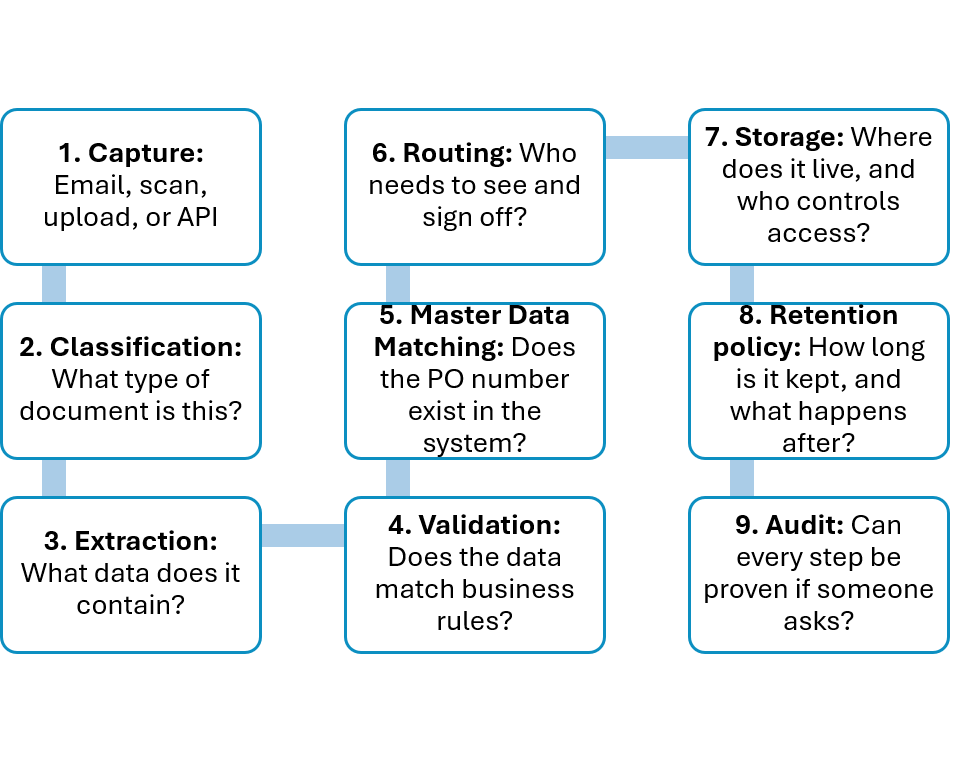
An LLM can contribute to multiple steps. That's generally not enough. All nine steps need to work together in a single, governed system – and that's what DocuWare IDP is built to do.
DocuWare IDP: AI built for the Document Processing pipeline
Intelligent Document Processing (IDP) is a category of AI software designed to get usable, structured data out of business documents. It combines optical character recognition (OCR), document splitting, machine learning, and natural language processing to handle the full processing pipeline, automatically and at scale.
For a broader look at the IDPmarket, AIIM's IDP Market Research Summary is a useful reference.
While LLMs can read a document and, with the right API configuration, return structured data in formats like JSON, they aren't designed for the end-to-end workflow that enterprise document automation requires. DocuWare IDP is built on this principle.
The IDP Pipeline: From document capture to verified business data
DocuWare IDP combines six core capabilities into one production pipeline:
OCR converts scanned images and PDFs into machine-readable text, with high accuracy even on difficult document types including handwriting and low-quality scans.
Splitting automatically separates mixed or batched document scans into individual records.
Classification identifies the document type: invoice, contract, purchase order, delivery note – without manual sorting or routing.
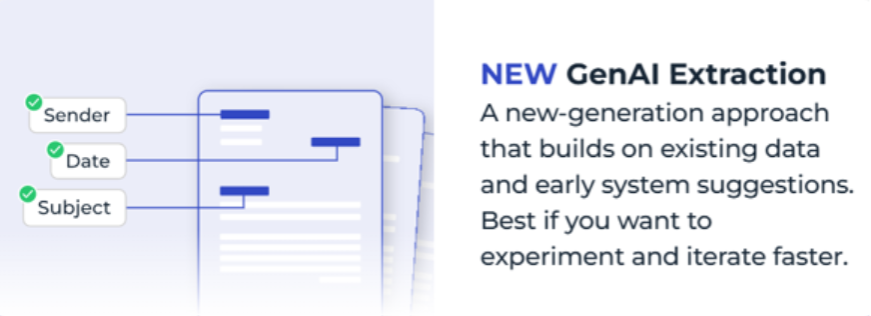
Extraction pulls specific data fields from each document type. With GenAI Extraction, organizations simply specify which fields they need: invoice date, PO number, vendor name, and the AI identifies and extracts them immediately, even from document types and layouts it hasn't encountered before. No templates, annotated samples, or manual configuration required.
Validation checks extracted values against configurable business rules before any data enters a downstream system.
Master Data Matching connects extracted values to verified records in the ERP, CRM, or other business systems. Recognizing "ACME Industrial Corp" in a document is useful. Matching it to the correct verified supplier record, confirming the PO number exists, and handing a verified result into the workflow – that's what creates real automation.
ChatGPT gives an answer. DocuWare IDP gives a process-ready result.
Smart automation knows when to stop
This is one of the most important distinctions between a general-purpose AI assistant and a production document automation system.
A general-purpose AI assistant is designed to try to answer. An automation system must know when not to.
If an invoice number can't be extracted with sufficient confidence, the right outcome is an exception flag, not an educated guess passed downstream into business systems. DocuWare IDP enables you to configure confidence thresholds to determine which documents flow through automatically and which are routed for human review. Reliable documents process without interruption. Uncertain cases are caught before leading to more errors.
This exception-routing mechanism is what separates an AI demo from a production-grade document automation system. In invoice processing, contract management, HR onboarding, and compliance-sensitive workflows, accuracy and control matter as much as speed.
DocuWare IDP is also designed to scale and improve over time. Extraction models can be benchmarked, versions compared, regressions detected, and automation rates measured against defined quality thresholds. Specialized models handle simpler tasks; more capable AI is applied where it adds value; deterministic rules are used where variability is unacceptable; human review is preserved where uncertainty remains. The right intelligence for the right problem — at every step of the pipeline.
You can review our full compliance and certification details here.

How LLMs and DocuWare IDP compare
|
Common Assumption |
Typical LLM-Only Approach |
DocuWare IDP |
|
LLMs can process all document types |
Many LLMs can process text and images, and some use OCR as part of their workflow. Accuracy drops with unclean data: crumpled, upside-down, or handwritten documents. |
Handles images, scans, handwriting, and structured extraction in one pipeline. OCR, splitting, classification, extraction, and Master Data Matching are built in. High accuracy even on difficult document types. |
|
LLMs are secure enough for enterprise use |
Many LLMs operate in public clouds or multi-tenant environments that may not meet compliance or audit requirements. |
On-premises or private cloud deployment. SOC 2 and ISO 27001 certified, configurable for HIPAA, GDPR, and CCPA, with regional data residency and access controls. |
|
LLMs provide adequate auditability |
Enterprise tiers offer admin audit logs, but these track conversations rather than individual documents. Most LLMs don't provide document-level data lineage or explainability for how outputs are generated. |
Complete audit trails for every document interaction: extraction, validation, Master Data Matching, routing, and filing, supporting internal and external audits and regulatory reviews. |
|
LLMs can skip lengthy setup |
LLMs require custom code for preprocessing, error correction, and integration. Prompt engineering, post-processing, and output reformatting are needed to connect with backend systems. |
Ready-to-use classification, extraction, splitting, validation, and Master Data Matching pipelines. Output goes directly to DocuWare workflows and connected business systems. |
|
LLMs can handle repeat document tasks efficiently |
ChatGPT offers Projects, Custom GPTs, and cross-conversation memory – useful features for general-purpose AI use. But there is no native mechanism to track which documents have been processed, enforce extraction rules across a batch, or route validated output into backend systems. |
Extraction fields and routing rules are configured once. The system processes every document the same way, with every document tracked from intake to filing. Workflows are shared across the team and every step is auditable. |
DocuWare Aura: AI with access to the right business context
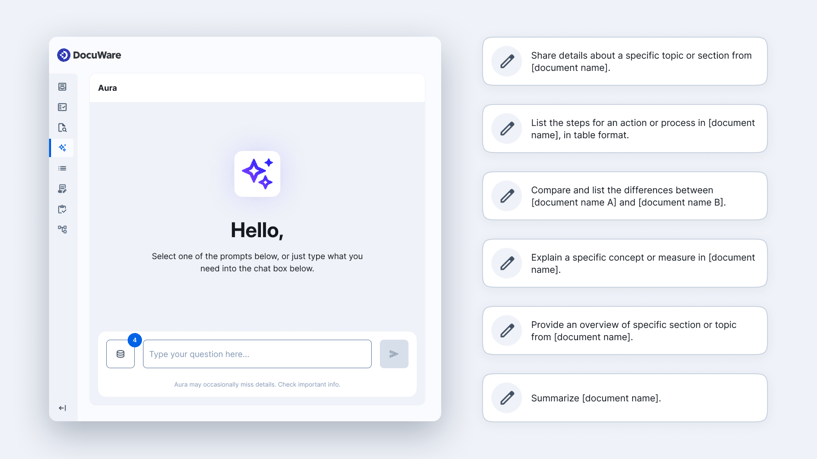
DocuWare IDP handles the document processing pipeline. DocuWare Aura addresses a fundamentally different challenge: helping employees find and reason with the knowledge that already lives across the organization's governed document archive.
The distinction is significant. LLMs help users reason about information they bring to it. DocuWare Aura helps users reason about information their organization already governs.
A co-pilot, not an oracle
When an answer matters, users need to understand where it came from.
DocuWare Aura is designed as a co-pilot, not an oracle.
The principle is straightforward: don't trust the AI because it sounds confident. Trust the answer because the evidence is inspectable.
With a general-purpose AI assistant, users typically need to supply the context themselves.
This means finding the right files, uploading them, connecting systems, or trusting that the retrieval layer will surface the right content. In organizations managing large document archives, that's a significant burden. And the reliability of any answer depends entirely on whether the user found the right source material to begin with.
DocuWare Aura flips the script.
The user asks the question. DocuWare Aura finds the business information needed to answer it.
Consider a question a legal or procurement team might ask: "Which supplier contracts expire this year and contain automatic renewal clauses?"
A general-purpose AI assistant can understand the clause: if the right contract is provided.
DocuWare Aura can identify which contracts across the entire archive are relevant, narrow the search using structured business information, inspect the content, and synthesize the evidence into a coherent answer.
Access rights are not optional for Enterprise AI
Not every employee should receive the same answer to the same question. Finance, HR, Sales, Legal, and Management work with different information and operate under different document permissions.
DocuWare Aura operates within DocuWare's governed environment. Every answer is bound by the access rights of the person asking the question. The same query submitted by a Finance manager and an HR coordinator returns different results, not because different AI logic is applied, but because the governed environment determines what each person is authorized to see.
The question isn't only "Can the AI answer this?" It's also "Should this user receive this answer?" DocuWare Aura is built for both.
Choosing the right tool for your business
ChatGPT and DocuWare's AI capabilities are both powered by advanced AI, and both are valuable, but they aren't the same category of solution.
The question was never which one to choose. It's understanding which layer each one operates at and making sure document processes have the full stack.
Organizations that understand this distinction and build it into their operations, combining the flexibility of general-purpose AI with the precision, governance, and auditability of purpose-built document AI, are the ones positioned to move faster and with greater confidence.
Speed matters. Trust matters more.