
Automating AP processes creates a more productive, error-resistant business environment. This article reviews the benefits and challenges of automating 3-way matching and offers tips for a smooth implementation. With digital records and real-time validation, your company can reduce cycle times, improve compliance and better allocate AP team resources.
Table of Contents
- What is 3-way invoice matching?
- How does the 3-way matching process work?
- Challenges of manual 3-way matching
- Automating 3-way invoice matching
- Best practices for implementing 3-way matching
- Conclusion: Future trends in accounts payable efficiency
What is 3-way invoice matching?
Three-way invoice matching is a crucial accounts payable (AP) process that ensures three key documents — a purchase order (PO), a receiving report (or goods receipt), and a supplier invoice — are accurately aligned before payment approval. This verification step ensures that what was ordered, what was received, and what is being billed all correspond in quantity, price and terms.
The 3-way matching process is a cornerstone of internal financial controls that reduce risk, prevent payment errors and minimize fraud. It ensures that only legitimate, accurate transactions are approved by the AP department.
Why 3-way matching matters in accounts payable
Errors in invoice processing are time-consuming and costly. Overpayments, duplicate payments and payments for goods never received are common slip-ups that manual AP processes can increase. The three-way matching process helps safeguard your company by confirming transaction integrity before funds are released.
Three-way matching fosters stronger procurement controls throughout a company. By requiring that all purchases start with a formal PO and are verified upon receipt, companies encourage better collaboration between finance, operations, and purchasing teams. This reduces errors, accelerates reconciliation and builds stronger vendor relationships.
How does the 3-way matching process work?
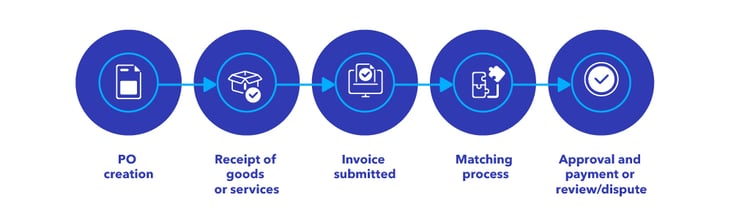
Step-by-step workflow
The three-way matching process follows a clear sequence of steps involving multiple teams and documents. Here’s how a typical three-way matching workflow unfolds:
- Purchase order creation: The procurement team issues a PO that outlines quantities, descriptions and agreed-upon prices.
- Receipt of goods: The receiving team logs the quantity and condition of items received through a receiving report.
- Invoice submission: The vendor sends an invoice for the goods or services delivered.
- Matching process: The AP department compares all three documents — PO, receipt, and invoice — for consistency.
- Invoice approval and payment: If all data points match, the invoice is approved for payment. Any discrepancies trigger a review or dispute resolution process.
Key Documents: purchase order, receipt and invoice
These three essential documents form the foundation of the three-way matching process:
- Purchase order (PO): Serves as an official document requesting goods or services, specifying quantities, prices, and terms agreed upon.
- Confirmation of receipt or delivery: Verifies the delivery of goods or services and is typically generated by warehouse or receiving personnel.
- Invoice: The bill sent by the supplier, which must correspond with the PO and receipt, to move forward in the payment process.
Benefits of 3-way invoice matching
Fraud prevention and error reduction
Three-way matching helps flag discrepancies early, preventing fraudulent invoices or billing errors from slipping through. Requiring all three documents to align significantly reduces the risk of incorrect or fraudulent payments.
Improved audit readiness and compliance
Three-way matching helps AP teams maintain thorough documentation and stronger controls, making internal reviews and external audits more straightforward. Auditors prefer working with reports from automated systems because they are fully searchable for quick retrieval of documents they need, catch errors in the early stages of the process and enforce financial policies.
Using AP automation software ensures that documents and data are securely captured, processed and stored, safeguarding them from misuse or loss. In addition, a solid rights structure controls which users can view, edit, export and delete documents and data. This maintains confidentiality by confirming that only authorized users have access to the information. Setting up these access rights ensures invoices cannot be altered without permission and all changes can be tracked.
Faster payment cycles and increased cost savings
Although manual three-way matching can be time-consuming, workflow automation streamlines the process. Faster approvals reduce late payment penalties, increase early payment discounts and lower overall operational costs. Automation also helps reduce the burden on AP staff, freeing them to focus on strategic tasks.
Implementing three-way matching also supports better cash flow forecasting. When invoice approval timelines are more predictable, finance managers can manage outgoing payments with greater precision. This enhanced financial visibility further strengthens performance and control within AP operations.
Challenges of manual 3-way matching
Common pain points and risks
Manual three-way matching creates these barriers to productivity:
- Wasted time: Reviewing and matching documents by hand slows down the AP process.
- Human error: Manual data entry raises the likelihood of mistakes and oversights occurring.
- Inefficiency: Employees spend extra time double-checking their work rather than directing their effort to higher-value tasks.
- Bottlenecks: Mismatched data can delay payments, damage supplier relationships and introduce exposure to regulatory noncompliance.
Manual processing not only places a heavy burden on staff but also restricts scalability, especially as businesses expand or work with more vendors. Additionally, without a centralized system, real-time visibility is limited. This makes it difficult to track documents across departments, causing further approval delays.
Automating 3-way invoice matching
How automation transforms accounts payable
Automated solutions simplify the three-way matching process by integrating procurement, receiving and accounts payable documents into one workflow. When an invoice is submitted, the system automatically matches it against the PO and receipt. Discrepancies are flagged instantly, and workflows can be configured to route exceptions for review or escalate them to the right person.
The role of intelligent document processing (IDP)
AI-driven invoice processing tools like DocuWare Intelligent Document Processing (IDP) extract data from scanned and digital documents. IDP incorporates advanced optical character recognition (OCR) and handwriting text recognition (HTR) with machine learning (ML), which is a subset of AI. Machine learning models are "trained" to recognize information in documents to enable accurate classification and precise data extraction. These models learn to detect patterns, predict outcomes and make decisions.
IDP also employs deep learning, a specialized ML technique that uses layers of algorithms called artificial neural networks. Natural language processing (NLP) is another component of IDP. NLP allows the software to understand human language. IDP also captures line-item details from purchase orders, receipts, and invoices to perform automatic comparisons.
Digital transformation: Moving beyond manual checks
Modern AP automation platforms enable organizations to move beyond manual checks and create a more efficient, error-resistant environment. With digital records and real-time validation, businesses can reduce cycle times, improve compliance and better allocate AP team resources.
Best practices for implementing 3-way matching
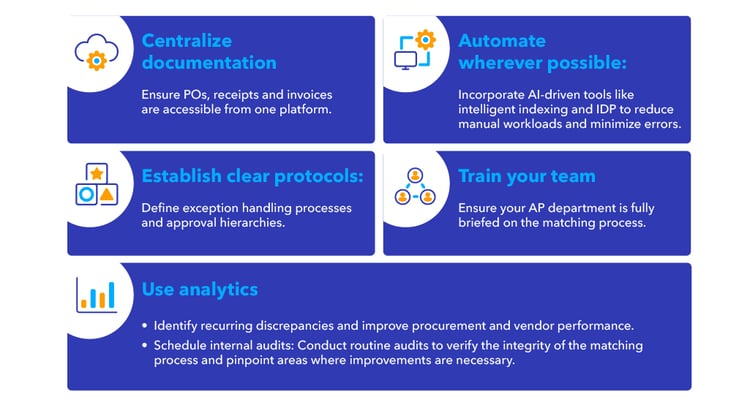
Tips for streamlining your AP workflow
- Centralize documentation: Ensure POs, receipts and invoices are accessible from one platform.
- Automate wherever possible: Incorporate AI-driven tools like intelligent indexing and IDP to reduce manual workloads and minimize errors.
- Establish clear protocols: Define exception handling processes and approval hierarchies.
- Train your team: Ensure your AP department is fully briefed on the matching process.
- Use analytics: Identify recurring discrepancies and improve procurement and vendor performance.
- Schedule internal audits: Conduct routine audits to verify the integrity of the matching process and pinpoint areas where improvements are necessary.
Choosing the Right Document Management Solution
Finding the right automation tool is crucial for effective accounts payable management. DocuWare provides powerful features designed for AP teams, including automated three-way matching, exception handling and real-time audit logging.
For long-term success, select a vendor that provides dedicated support, proven implementation expertise, and scalability to grow with your business.
Additionally, consider how well the solution integrates with your existing enterprise systems. Seamless connections with ERPs, procurement and accounting software enhance data consistency and reduce the risk of duplicate entries. Look for platforms that offer customizable workflows and analytics dashboards to monitor real-time performance.
Conclusion: Future trends in accounts payable efficiency
As business transactions grow in volume and complexity, three-way invoice matching remains a vital control in accounts payable. Automating the three-way match turns a traditional bottleneck into a strategic advantage. In the future, companies will continue to find innovative ways to boost performance through smarter automation. Implementing AI-powered solutions within accounts payable departments will influence and improve the way AP departments transact business. By automating repetitive tasks, obtaining real-time insights and improving forecasting, organizations will find new, highly effective approaches that minimize payment issues.
Ready to transform your invoice matching? Get started with automated invoice processing.