What is the Difference between Purchase-to-Pay and Invoice Processing?
The difference between purchase-to-pay (P2P) and invoice processing mainly lies in the scope and the stages of the procurement process they cover:1. Purchase-to-pay (P2P):
-
Scope: P2P is a broader process that encompasses the entire journey of procuring goods or services, starting from the initial purchase decision to the final payment.
-
Stages: It includes identifying the need for a product or service, selecting a supplier, creating and sending a purchase order, receiving the goods or services, processing the invoice and finally making the payment.
-
Purpose: P2P aims to optimise the entire procurement cycle, improve cost savings, ensure compliance with corporate policies and strengthen supplier relationships.
2. Invoice processing:
-
Scope: Invoice processing is a subset of the P2P process. It focuses specifically on the handling and management of supplier invoices.
-
Stages: This process includes receiving the invoice, verifying it against purchase orders and delivery notes (3-way match), resolving any discrepancies, obtaining necessary approvals and making the payment.
-
Purpose: The main purpose of invoice processing is to ensure accurate and timely payments to suppliers, maintain accurate financial records and prevent fraud.

Companies tend to start their P2P automation journey by optimising supplier invoice processing first, as this is typically where the most manual effort is spent and is therefore more prone to error. Invoice processing takes time to validate the information on the invoice, match it to what was ordered/received, capture the transactional data into an accounting system and approve the payment to the supplier. By automating these three areas of invoice processing, significant time savings can be made and the risk of incorrect payments is greatly reduced. The benefits are reduced departmental costs, a faster and more efficient process, control over the process and, of course, improved supplier relationships.

P2P vs. Invoice Processing
See how to secure your documents, set up digital workflow and kick your productivity to a new level.
How does purchase-to-pay work with DocuWare?

Approval: Once the requisition has been submitted, it goes through an approval process. This usually involves a manager or designated approver reviewing the request to ensure that it aligns with budgetary constraints and organisational needs. The approver may ask for additional information or clarification and has the authority to approve, reject or modify the requisition. This step ensures that the expenditure is controlled and authorized.
Order: Once approved, the order is formally issued to the supplier. This step involves generating a purchase order (PO), which includes detailed information about the order, such as item descriptions, quantities, prices and delivery terms. The PO is then sent to the supplier, who confirms receipt and agrees to fulfil the order as specified. This step is critical in formalising the procurement agreement.
How does invoice process work with DocuWare?
The invoice process is a subset of the P2P process and focuses on streamlining and automating the accounts payable workflow. This process consists of the following five steps:
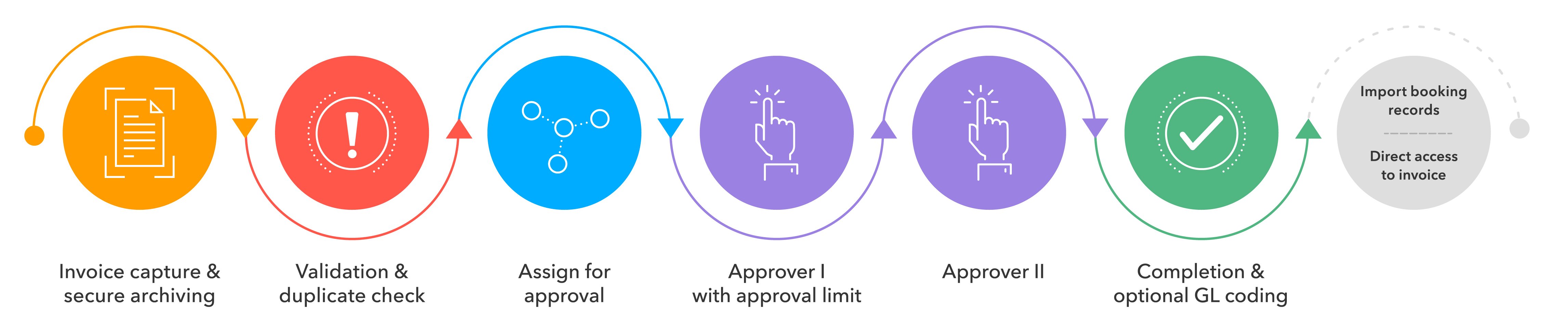
Validate and duplicate check of invoices according to your organisation’s specific business procedures and criteria (duplicate or fraudulent invoices).
Assign for approval – depending on the process, invoices are either automatically or manually assigned to approvers who must approve or reject them.
Which is right for me: P2P or invoice processing?
To determine whether a full purchase-to-pay (P2P) solution or an invoice processing solution is right for you, it’s essential to consider your organisation’s specific needs and processes. Here are some key factors to help make your decision:
-
Scope and complexity of your procurement process:
-
If your organisation has a complex procurement process that involves multiple steps from requisition to payment, a P2P solution may be more suitable. P2P systems manage the entire process, including requisition, approval, purchase order creation, receipt, invoice processing and payment.
-
If your primary concern is managing the receipt, approval and payment of invoices, particularly if you're dealing with a high volume of invoices or need to automate these specific tasks, an invoice processing solution may be more appropriate.
-
-
Integration with existing systems:
-
P2P systems are often comprehensive and can integrate with your existing ERP (Enterprise Resource Planning) system, providing a seamless data flow across procurement, finance and supply chain management.
-
Invoice processing systems tend to focus on the accounts payable aspect and may be easier to integrate with an existing financial system without overhauling your entire procurement process.
-
-
Organisational size and growth:
-
Larger organisations or those experiencing rapid growth may benefit more from a P2P system due to its scalability and ability to handle complex procurement needs across different departments or locations.
-
Smaller organisations or those with less complex procurement needs may find an invoice processing system sufficient and more cost effective.
-
-
Need for compliance and reporting:
-
If your organisation requires strict compliance with regulatory standards and needs robust reporting and audit trails for the entire procurement process, a P2P system can provide these capabilities more comprehensively.
-
For basic compliance and reporting requirements focused primarily on financial transactions, an invoice processing system might be sufficient.
-
-
Budget and resources:
-
Implementing a full P2P system can be a significant investment in terms of time, money and training. If your organisation has the resources and sees the value in a comprehensive system, it may be the right choice.
-
An invoice processing solution can be less expensive and quicker to implement, making it a practical choice for organisations with limited resources or those looking for a solution with a faster return on investment.
-
-
Strategic goals:
-
Consider your organisation's long-term strategic goals. If optimising the overall procurement process is aligned with these goals, a P2P system may provide more value.
-
If improving the efficiency and accuracy of invoice processing is a more immediate concern, then an invoice processing solution would be more relevant.
-
| P2P |
Invoice processing solution |
|---|---|
| Suitable for complex processes from requisition to payment | Focused on managing receipt, approval and payment of invoices |
| Integrates with ERP systems, affecting procurement, finance and supply chain |
Easier to integrate into existing financial systems |
| Ideal for larger or rapidly growing organisations |
More suitable for smaller organisations or those with less complex needs |
| Comprehensive compliance and reporting for the entire procurement process |
Basic compliance and reporting, focused on financial transactions |
| Typical P2P solutions require a significant investment, requiring more resources and training. But with DocuWare, the investment starts at £20,000. |
Less expensive, faster to implement, requires fewer resources |
| Aligns with objectives to optimise the entire procurement process |
Relevant for immediate improvement in efficiency and accuracy of invoice processing |
| Recommended for stockholding companies (e.g., manufacturing, retail, e-shops, etc.), especially if the business size is over £20 million |
Better suited for SMBs with small operations or those with a business size below £20 million |